
🕐9 min read
In This Article
Dream Journal & Interpretation Kit
30-day dream journal with interpretation guides, symbol dictionary, and lucid dreaming techniques.
- The Archive of the Unconscious: Why Dreams Resist Simple Decoding
- The Jungian Lens: Archetypes, Shadow, and the Compensatory Function
- What the Laboratory Says: Sleep Science and the Neurobiology of Symbol-Making
- Cross-Cultural Case Files: How Different Traditions Read the Same Symbols
- Falling, Flying, Teeth, and Water: Four Recurring Case Files
- Cross-Reference: How Four Interpretive Systems Read the Same Five Symbols
- Reflection Questions for the Waking Mind
- Building a Dream Journal Practice: Prompts and a Lucid Dreaming Checklist
Disclosure: This post contains affiliate links. If you click through and make a purchase, we may earn a small commission at no extra cost to you. Thank you for supporting this site!
In 1966, psychologist Calvin Hall and his colleague Robert Van de Castle sat down with more than 1,000 dream reports and did something almost nobody in the field had done before: they counted things. Not vibes, not archetypes — actual frequencies. How often did strangers appear versus family members? How often did the dreamer fly, fall, or find themselves inexplicably undressed in a grocery store? Their coding system, still used today as the Hall/Van de Castle norms, revealed that roughly 8% of dreams contain aggression and only about 2% contain overtly sexual content — a finding that quietly demolished decades of Freudian assumption. This is the strange middle ground where dream interpretation now lives: part laboratory, part archive, part campfire story passed down from cultures that never needed a sleep lab to take dreams seriously. Decoding a nighttime symbol isn’t about looking it up in a dictionary. It’s about triangulating between neuroscience, depth psychology, and the accumulated dream-record of human civilization — and sitting, a little uncomfortably, with the fact that no single lens gets the whole picture.
The Archive of the Unconscious: Why Dreams Resist Simple Decoding
Every dream dictionary ever printed promises the same thing: turn to page 114, find “teeth falling out,” get your answer. The trouble is that this format has never survived contact with actual research. When Domhoff and Adam Schneider built the Sleep and Dream Database (SDDb) at UC Santa Cruz — now holding over 30,000 dream reports — they found that symbol meaning shifted depending on the dreamer’s age, culture, current stressors, and even the decade the dream was recorded in. A falling dream logged by a college student in 1950s Cleveland doesn’t carry the same charge as one logged by a gig-economy worker in 2024.

This is why the archival approach — treating each dream as a case file rather than a verdict — tends to hold up better than the dictionary approach. A case file asks: who dreamed this, when, under what conditions, and what patterns repeat across their personal dream history? Hall and Van de Castle’s own data showed that the same symbol (a body of water, say) appeared in wildly different emotional registers depending on whether the dreamer was navigating grief, a new relationship, or, in one memorable cluster of reports, finals week.
So the first rule of a scientific approach to symbolism is almost anti-symbolic: context outweighs content. The second rule, which the rest of this piece leans on heavily, is that multiple interpretive frameworks — Jungian, neurocognitive, cross-cultural — tend to triangulate toward something more honest than any one of them alone.
The Jungian Lens: Archetypes, Shadow, and the Compensatory Function
Carl Jung spent over 40 years cataloguing what he called archetypal imagery — recurring figures like the Shadow, the Anima/Animus, the Wise Old Man, the Great Mother — that surfaced across his patients’ dreams with a consistency he found impossible to explain through personal biography alone. His 1934 essay “The Archetypes and the Collective Unconscious” argued that dreams perform a compensatory function: they surface what the waking ego has ignored, overvalued, or suppressed. A dream about being chased, in this lens, isn’t a literal warning. It’s more often read as an invitation to examine what part of the self is being outrun.
Jung’s own dream journal, published posthumously as part of “The Red book” (Liber Novus) between 1913 and 1930, is the clearest primary-source record of this method in action. He didn’t decode his dreams so much as have prolonged conversations with them — a technique he called active imagination, where the dreamer re-enters the dream image while awake and lets it continue developing. Modern Jungian analysts, including those trained at the C.G. Jung Institute in Zurich, still use this technique in clinical practice, and it remains one of the few dreamwork methods with decades of continuous case documentation behind it.
The limitation worth naming: Jungian interpretation is descriptive and clinical, not experimentally falsifiable in the way a sleep-lab EEG study is. That doesn’t make it wrong — it makes it a different kind of evidence, closer to case law than physics. Treat it as one lens among several, useful for meaning-making rather than diagnosis.
Want deeper dream insights?
Free weekly — no spam, unsubscribe anytime.
What the Laboratory Says: Sleep Science and the Neurobiology of Symbol-Making
Harvard psychiatrist J. Allan Hobson’s activation-synthesis hypothesis, first proposed in 1977 and refined into the AIM model by the 2000s, offers a much colder account: dreams are the forebrain’s attempt to narrate essentially random signals firing from the brainstem during REM sleep. Under this model, a dream about drowning isn’t a symbol of anything — it’s the cortex pattern-matching chaotic neural noise into the nearest available story, the way a person might see a face in a cloud formation.

Finnish cognitive scientist Antti Revonsuo complicates this with his threat simulation theory, published in 2000, which found that roughly 70% of dream content across cultures involves some form of threat, chase, or danger. Revonsuo argues this isn’t noise — it’s evolutionary rehearsal, a nightly flight-simulator for real-world danger response. Notably, dream researcher Tore Nielsen at the University of Montreal’s Dream and Nightmare Laboratory found that trauma survivors show measurably higher rates of threat-dream recurrence, with some studies putting nightmare frequency at 3-4 times the general population’s baseline.
Rosalind Cartwright’s mood-regulation research at Rush University in Chicago, spanning studies published from the 1990s through 2010, found something practically useful: dreamers going through divorce who dreamed directly about their ex-spouse (rather than symbolic substitutes) showed better depression-recovery scores a year later. Her data suggests dreams may function as emotional processing rather than pure symbol generation — a claim that sits uneasily next to Jung but doesn’t outright contradict him either.
Cross-Cultural Case Files: How Different Traditions Read the Same Symbols
Long before REM sleep had a name, the ancient Egyptians were already running a systematic dream practice. The Ramesside Dream book, a papyrus dated to roughly 1200 BCE and now held at the British Museum, lists over 200 dream scenarios with corresponding interpretations — a snake dream, for instance, was read as prosperity, while a dream of one’s teeth falling out was read as a warning about loss among family. That’s roughly 3,200 years of continuous human interest in the exact symbol Western dream dictionaries still argue about today.
In 11th-century Persia, the scholar Ibn Sirin compiled what became one of the most cited Islamic dream manuals, “Tafsir al-Ahlam,” which is still referenced in parts of the Middle East and South Asia. Ibn Sirin’s system was notably contextual rather than fixed — the same object could mean prosperity or ruin depending on the dreamer’s moral state, a detail that maps surprisingly well onto the modern research finding that context outweighs content.
The Senoi people of the Malaysian highlands, documented (and later contested) in Kilton Stewart’s 1935 anthropological accounts, reportedly treated dream-sharing as a communal morning ritual, with children taught to confront and befriend dream antagonists rather than flee them. Anthropologists have since debated how accurately Stewart represented Senoi practice, but the core idea — that engaging a dream figure changes its recurrence — has since been echoed independently in Western lucid dreaming research, particularly Stephen LaBerge’s work at Stanford in the 1980s.
Australian Aboriginal Dreamtime traditions take a different angle entirely, treating dreams not as personal psychological data but as access points to an ancestral, ongoing creation-time that runs parallel to waking life. This framework doesn’t ask “what does this symbol mean to me” so much as “what is this dream connecting me to” — a distinction that Western clinical psychology, built around the individual psyche, tends to underrepresent entirely.
Falling, Flying, Teeth, and Water: Four Recurring Case Files
Falling dreams show up in roughly 1 in 3 people’s recalled dream history according to Hall/Van de Castle-style survey data, often clustering around periods of perceived loss of control. The Jungian reading treats falling as ego destabilization — the conscious self losing its footing relative to unconscious material rising up. The neurobiological reading is blunter: falling sensations frequently correlate with the hypnic jerk, a myoclonic twitch that occurs during the transition into sleep and gets retroactively narrated by the brain as a fall.
Flying dreams, reported by an estimated 10-20% of dreamers at least once in their lives, split interpretation just as sharply. Jung associated flight with a psyche attempting to transcend a limiting situation. Revonsuo’s threat-simulation framework has less to say here, since flying isn’t a threat rehearsal — which is part of why flying dreams are disproportionately common in lucid dreaming reports, where the dreamer has enough cortical control to choose euphoria over danger.
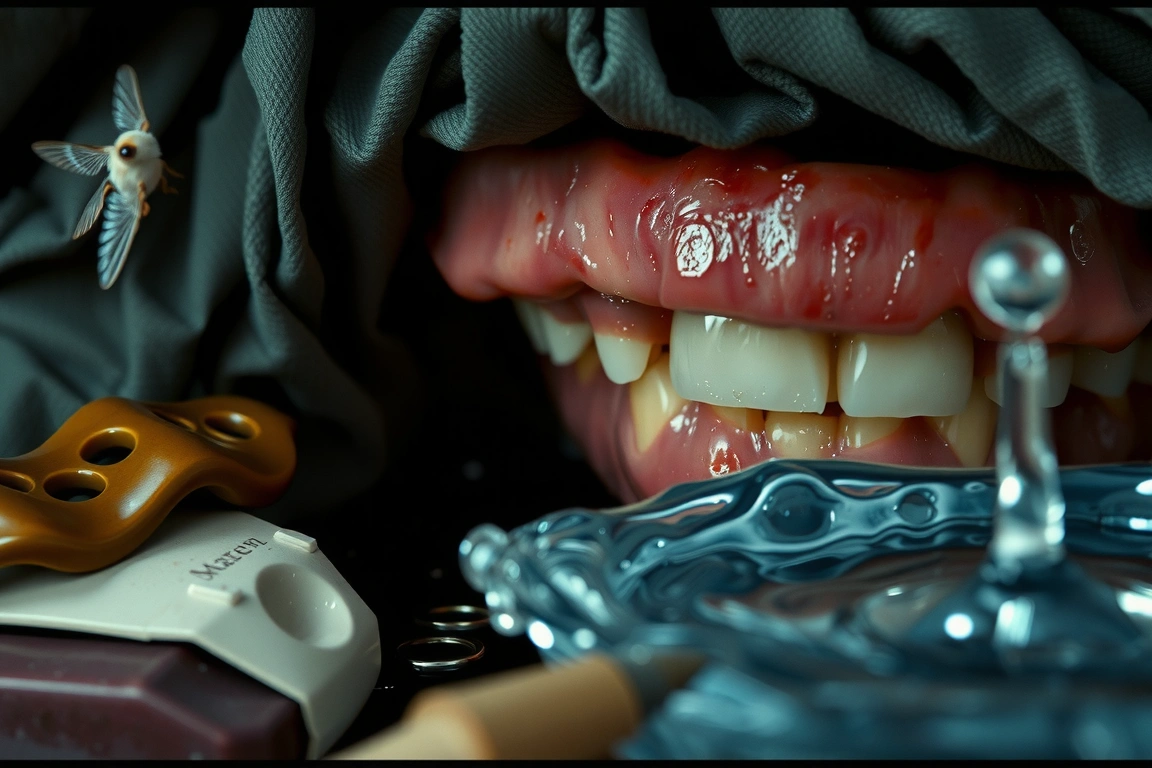
Teeth-falling-out dreams appear in an estimated 7-39% of people depending on the study population, one of the widest reported ranges in dream research, largely because studies define “teeth dream” inconsistently. Cross-culturally the symbol is remarkably stable: ancient Egyptian, Chinese Zhougong Jiemeng traditions, and Ibn Sirin’s manual all independently link it to loss, aging, or family rupture, which is a striking convergence for a symbol with no single agreed neurological trigger.
Water dreams resist easy synthesis more than any other category. Depth psychology tends to read water as unconscious material itself — murky water for repressed content, clear water for emotional clarity. Cartwright’s mood-regulation data found water dreams spiking during major life transitions rather than correlating with any single emotion, which suggests water may function less as a fixed symbol and more as an emotional intensity dial, amplifying whatever else is present in the dream.
Cross-Reference: How Four Interpretive Systems Read the Same Five Symbols
Laid side by side, the disagreement between frameworks becomes almost as informative as any single interpretation. The table below isn’t a decoder Ring — it’s closer to a comparative case log, the kind a dream researcher might keep pinned above a desk.
| Symbol | Jungian Reading | Neurocognitive Reading | Ancient Egyptian (Ramesside) | Ibn Sirin (11th c.) |
|---|---|---|---|---|
| Snake | Shadow / transformation | Threat-simulation trigger, high salience animal fear | Prosperity or authority | An enemy, or hidden knowledge depending on color |
| Water (murky) | Repressed unconscious material | Emotional intensity marker, transition periods | Purification or danger, context-dependent | Trouble or illness |
| Flying | Transcendence of limitation | Lucid/euphoric cortical control state | Rising status | Elevated rank or travel |
| Teeth falling out | Fear of aging, loss of potency | Possible correlation with tooth-grinding/bruxism | Loss among family | Death of a relative or financial loss |
| Being chased | Avoidance of shadow material | Threat-rehearsal, elevated in trauma survivors | Fleeing an enemy in waking life | Escaping a real obstacle or debt |
Notice how often the frameworks land in the same emotional neighborhood — loss, threat, elevation — while disagreeing on mechanism. That convergence is arguably more trustworthy than any single tradition’s confidence.
Reflection Questions for the Waking Mind
A dream symbol only becomes useful once it’s brought back into daylight and interrogated a little. Instead of asking “what does this mean,” dream researchers including Deirdre Barrett at Harvard Medical School — known for her studies on dream-based problem-solving — suggest asking what the dream’s emotional tone matched in the 24-48 hours before sleep. Barrett’s 2001 research on dreams and creative problem-solving found that roughly 50% of dreamers could trace a dream image back to a specific unresolved concern from the prior day or two.
Useful reflection questions to sit with after waking: What was the dominant feeling in the dream — not the plot, the feeling? Who else was present, and does that person’s real-world role match their dream role? Did the dream resolve, or did it cut off mid-tension, the way roughly 60% of nightmare reports do according to Nielsen’s Montreal lab data? And finally: has this exact symbol appeared before, and if so, what was happening in life the last time it showed up?
None of these questions produce a verdict. They produce a pattern, logged over weeks rather than diagnosed overnight — which is really the only honest way dream symbolism has ever worked, in a Zurich analyst’s office or a Cairo dream-temple three thousand years ago.
Building a Dream Journal Practice: Prompts and a Lucid Dreaming Checklist
Stephen LaBerge’s MILD technique (Mnemonic Induction of Lucid Dreams), developed at Stanford’s Sleep Research Center in the
You Might Also Like



What Are Your Dreams Telling You?
Join The Dream Files — weekly dream symbols, hidden meanings, and the archive that maps 4,000 years of the subconscious.
No spam. Unsubscribe anytime.
