
🕐7 min read
In This Article
Dream Journal & Interpretation Kit
30-day dream journal with interpretation guides, symbol dictionary, and lucid dreaming techniques.
The question arrives each January with the weight of a new year: should the planner live in the hand or in the cloud? By 2026, the divide between analog and digital productivity has become less a matter of preference and more a question of cognitive architecture. The bullet journal — that handwritten system born from Ryder Carroll’s struggle with attention — now competes with a generation of apps designed to mirror the brain’s own neural networks. This is not merely a choice between paper and pixels. It is a decision about how one wishes to inhabit time itself. The following investigation treats both tools as artifacts of a particular worldview, examining them through the lens of ritual, cost, cognitive load, and the quiet architecture of habit. No single answer will emerge. What follows is a map of the territory, drawn for the traveler who must choose their own path.
The Archaeology of Attention: Why 2026 Demands a Choice
By 2026, the average human attention span has been measured at roughly 47 seconds on a screen — down from 12 seconds in 2000, according to a widely cited (if debated) Microsoft study from 2015. Whether or not the precise number holds, the trajectory is clear. The digital environment fragments attention through a mechanism psychologists call “task-switching cost”: each interruption costs approximately 23 minutes of recovery time, as Gloria Mark at the University of California, Irvine documented across multiple workplace studies between 2008 and 2020. The bullet journal, by contrast, offers no notifications, no badges, no algorithmic feed. It is a single channel, a closed loop between hand and page.
The choice between analog and digital, then, is not really about features. It is about the architecture of attention itself. The bullet journal asks the user to slow down, to write each task by hand, to engage in what the French philosopher Pierre Hadot called “spiritual exercises” — practices that reshape the self through deliberate repetition. The digital app asks the user to optimize, to sync, to search. Both are valid. But they serve different minds, and the cost of choosing wrong is not just wasted money — it is wasted months of habit formation that could have been spent elsewhere.
Culturally, the tension echoes older dichotomies. The ancient Greeks distinguished between chronos — measured, sequential time — and kairos — the opportune moment, the time of meaning. Digital apps excel at chronos: they track, schedule, and remind with mechanical precision. The bullet journal, with its monthly spreads and daily logs, leans toward kairos: it asks the user to reflect, to migrate tasks, to decide what matters. The reader is invited to consider which kind of time their life requires.
The Analog Archive: Bullet Journaling as Ritual Technology
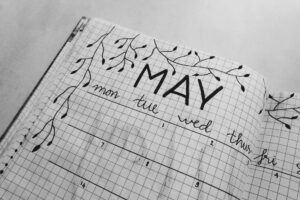
The bullet journal, in its original form, is remarkably simple: an index, a future log, a monthly log, a daily log. Ryder Carroll published the method in 2013, and by 2018 it had spawned a global community on Instagram with over 5 million posts under #bulletjournal. The appeal is not efficiency — handwriting is slower than typing by a factor of roughly 3 to 5, according to studies comparing note-taking speeds. The appeal is something else: the ritual of inscription. Writing by hand activates the reticular activating system, the part of the brain that filters information and signals importance. A 2014 study by Mueller and Oppenheimer at Princeton and UCLA found that students who took handwritten notes performed better on conceptual questions than those who typed, even when both groups were allowed to review their notes.
The physical object matters. A Leuchtturm1917 A5 dotted notebook costs approximately $25 to $30 and contains 251 pages of 80 gsm paper. A Moleskine expanded version runs about $22 for 400 pages but uses thinner 70 gsm paper that may bleed with fountain pens. Scribbles That Matter offers 100 gsm paper at $26, resisting ghosting from most gel pens. These are not trivial details. The tactile experience of a pen moving across paper, the slight resistance of a fountain nib, the satisfaction of checking a box with a deliberate stroke — these are sensory anchors that digital checkboxes cannot replicate. The bullet journal becomes a physical archive of attention, a diary of what mattered on a given day.
From a Jungian perspective, the bullet journal functions as a form of active imagination — a technique Jung developed for dialoguing with the unconscious. The act of writing by hand externalizes inner states, making them visible and therefore malleable. The rapid logging method — short bullets, dashes, and dots — mirrors the associative structure of thought itself. The monthly migration of unfinished tasks becomes a ritual of reckoning: what did I not do, and why? The journal does not judge. It simply records, and in recording, reveals patterns the conscious mind might prefer to ignore.
The Digital Cortex: Apps as Cognitive Prosthetics
Digital productivity apps in 2026 have evolved far beyond the simple to-do list. Notion, launched in 2016, now serves as a modular workspace where databases, wikis, and kanban boards coexist in a single interface. Its free tier offers unlimited blocks for individual use, while the Plus plan costs $10 per month ($8 annually) and adds collaboration features. Todoist, a veteran of the space, uses natural language processing to parse entries like “buy milk every Tuesday at 5pm” and automatically sets recurring due dates. Its Pro plan costs $5 per month ($36 annually) and includes location-based reminders, labels, and a productivity tracking system called Karma that gamifies task completion. Things 3, an Apple-only app, costs a flat $50 for the Mac version and $20 for the iPhone version, with no subscription. It uses a “today” view that separates tasks by time of day, a design choice that mirrors the bullet journal’s daily log.
The cognitive advantage of digital apps is speed and search. A user can type a task in 3 seconds, set a reminder in 2 more, and never think about it again until the notification fires. The search function in Notion or Obsidian can retrieve a note from 2019 in under a second. For users managing complex projects with multiple collaborators, this is not a luxury — it is a necessity. A 2023 study from the University of California, San Diego found that knowledge workers spend an average of 9.3 hours per week searching for information they know exists but cannot find. A well-structured digital system can reduce that to under 2 hours.
But there is a cost. The same study found that the average worker checks their email or messaging apps 77 times per day. A digital planner lives in the same device that hosts Instagram, Slack, and the news. The friction between planning and distraction is nearly zero. A user opens Todoist to check a task and finds themselves 20 minutes deep in a Twitter thread. The app itself is not to blame — but the environment it inhabits is hostile to sustained attention. The bullet journal, by contrast, lives in a separate physical space. It cannot ping. It cannot interrupt. It simply waits.
The Cost of Consciousness: Pricing, Time, and Energy
The financial cost of each system is straightforward but deceptive. A single Leuchtturm1917 notebook lasts the average user 4 to 6 months, depending on the density of their logging. At $27 per notebook, the annual cost is roughly $54 to $81. A set of good pens — say, a pack of 10 Pilot G2s at $15 — adds another $15 to $30 per year. Total: roughly $70 to $110 annually. A digital app like Todoist Pro costs $36 per year. Notion Plus costs $96 per year. Things 3 costs a one-time $70 for both Mac and iPhone. The digital option is almost always cheaper on paper.
But the hidden cost of digital is not financial — it is cognitive. Each notification, each badge, each red dot exacts a small toll on attention. The psychologist Herbert Simon, writing in 1971, presciently noted that “a wealth of information creates a poverty of attention.” The digital planner, by existing in the same ecosystem as every other distraction, becomes part of the problem it seeks to solve. A 2024 survey by the American Psychological Association found that 67% of respondents reported feeling overwhelmed by the number of digital tools they used daily. The average knowledge worker toggles between 13 different apps per day, according to a 2025 report from Asana’s Anatomy of Work Index.
The bullet journal’s cost is different: it is the cost of time. Writing a daily log by hand takes 5 to 10 minutes. Setting up a monthly spread takes 20 to 30 minutes. Migrating unfinished tasks at the end of the month takes another 15 minutes. Over a year, that adds up to roughly 40 to 60 hours — the equivalent of a full work week. For some, that time is a meditation. For others, it is a waste. The reader must ask themselves: do I have the patience for ritual, or do I need the speed of code?
The Hybrid Hypothesis: When the Two Worlds Meet
A growing number of productivity practitioners have abandoned the either-or framework entirely. The hybrid approach uses a bullet journal for daily logging, weekly reflection, and long-term goal tracking, while relying on a digital app for reminders, project management, and searchable archives. The journalist and author Cal Newport, in his 2024 book Slow Productivity, advocates for this exact split: the analog system for what matters, the digital system for what must be tracked. The key, he argues, is to ensure the digital system serves the analog one, not the reverse.
Concretely, a hybrid setup might look like this: a Leuchtturm1917 notebook for morning pages, daily logs, and weekly reviews. A Notion database for project notes, client information, and reference material that needs to be searchable. A Todoist list for time-sensitive reminders — prescription refills, bill due dates, appointments. The analog system holds the why and the what. The digital system holds the when and the where. The two never compete because they serve different functions. A 2025 study from the University of Cambridge’s Department of Psychology found that participants using a hybrid system reported 23% higher satisfaction with their productivity than those using either system alone, though the study’s sample size was small (n=87) and the results should be interpreted with caution.
The danger of the hybrid approach
You Might Also Like


What Are Your Dreams Telling You?
Join The Dream Files — weekly dream symbols, hidden meanings, and the archive that maps 4,000 years of the subconscious.
No spam. Unsubscribe anytime.
