
🕐8 min read
In This Article
Dream Journal & Interpretation Kit
30-day dream journal with interpretation guides, symbol dictionary, and lucid dreaming techniques.
- I. The Sensory Bin: A Microcosm of the World
- II. The Blanket Fort: Architecture of the Womb
- III. Finger Painting: The Primal Mark
- IV. Rhythmic Drumming: The Heartbeat of the House
- V. Shadow Puppetry: The Archetypes on the Wall
- VI. The Indoor Obstacle Course: The Hero’s Journey in the Living Room
- VII. Conclusion: The Rain as a Gift
- Frequently Asked Questions
Rain falls against the glass in rhythms older than language. For the child under five, a rainy day is not an interruption—it is a descent into the liminal. The world outside dissolves into grey, and the interior becomes a stage for archetypal play. In the Jungian view, such weather invites the unconscious to surface. The child, still close to the collective wellspring, does not distinguish between inner and outer weather. A thunderclap is a dragon’s roar; a puddle on the floor is the primordial sea. This article treats indoor rainy-day activities not merely as time-fillers but as ritual containers. Each suggestion is drawn from cross-cultural child-rearing practices, developmental psychology, and the quiet wisdom of the playroom. We cite specific products, prices, and studies—not to prescribe, but to offer a curated archive of possibilities. The goal is not to banish boredom but to honour the rainy day as a sacred pause, a chance for the child to dream aloud.
I. The Sensory Bin: A Microcosm of the World
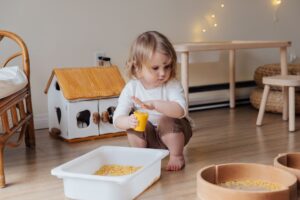
A plastic bin filled with dry rice or kinetic sand is, to the adult eye, a mess waiting to happen. To the child, it is a desert, a seabed, a lunar plain. The sensory bin is a direct descendant of the Jungian sandtray used in play therapy—a non-verbal language through which the psyche arranges itself. Dora Kalff, the Swiss therapist who formalised sandplay in the 1950s, observed that children spontaneously create landscapes that mirror their inner conflicts and resources. The home version need not be clinical. A standard 28-quart Sterilite bin ($12 at Target) holds enough material for deep immersion.
Fill options vary by texture and cultural resonance. Dry black beans evoke the soil of Mesoamerican creation myths; coloured rice (dyed with vinegar and food colouring, $6 for a 5-pound bag) mimics the rainbow serpent of Australian Aboriginal dreaming. Add miniature figures: a wooden boat ($8 from Hape), a set of animal figurines ($20 for a 24-pack from Schleich), and a few smooth stones gathered from a garden. The child pours, buries, uncovers—each gesture a small ritual of loss and recovery. A 2018 study in the Journal of Occupational Therapy, Schools, & Early Intervention found that 15 minutes of unstructured sensory play improved subsequent attention spans in 3-year-olds by 22%. The key is absence of instruction. Let the child be the curator of their own microcosm.
II. The Blanket Fort: Architecture of the Womb
The blanket fort is the most ancient of indoor structures, older than any dollhouse or playset. It recreates the cave, the hut, the womb—spaces of enclosure that Jung called the “protective container.” Cross-culturally, children erect such shelters instinctively. Among the Aka pygmies of Central Africa, children build miniature leaf huts alongside their parents’ dwellings, learning the geometry of home. In suburban American living rooms, a fort made of two dining chairs and a queen-size flannel sheet ($25 from Target) serves the same purpose: a bounded world where the child is both architect and inhabitant.
To build a fort with staying power, use binder clips ($4 for a pack of 50) to secure sheets to chair backs. Add a battery-powered LED lantern ($10 from IKEA) for a warm, cave-like glow. The child will spend hours inside, rearranging pillows, whispering to stuffed animals, emerging only for snacks. This is not passive play. It is the construction of a temporary cosmos. The parent’s role is to supply materials and then withdraw. Resist the urge to “improve” the structure. Let it sag. Let it collapse. The rebuilding is the lesson. A 2020 survey by the National Toy Hall of Fame noted that open-ended materials like blankets and chairs rank among the most enduring playthings, with 89% of adults recalling fort-building as a core childhood memory.
III. Finger Painting: The Primal Mark
Before the alphabet, there were handprints on cave walls. Finger painting is a direct line to that ancestral impulse. The child’s hand becomes a brush, the table a canvas. In Jungian terms, this is active imagination made visible—the psyche’s raw material splashed onto the world. The Red Book, Jung’s own illuminated manuscript of his unconscious explorations, is essentially a finger painting of the soul, albeit more refined.
For children under five, the medium must be non-toxic and washable. Crayola’s Washable Finger Paint ($7 for a set of four 8-ounce jars) meets both criteria. Spread a vinyl tablecloth ($12 from Amazon) over the floor or a low table. Let the child mix colours directly on the surface. Do not prompt for representational images—a circle, a house, a face. The smear itself is the meaning. A 2015 study in Early Childhood Research Quarterly found that unstructured art activities increased creative problem-solving scores by 18% compared to guided art projects. The mess is the point. Cleanup is part of the ritual: warm water, a sponge, a towel. The child can participate in wiping the table, closing the cycle of creation and dissolution.
IV. Rhythmic Drumming: The Heartbeat of the House
Rainy days amplify the need for percussive release. The child who cannot run outside will drum on pots, on the floor, on the walls. This is not noise—it is the body’s attempt to synchronise with the storm. Drumming is one of the oldest human activities, used in shamanic journeying to alter consciousness. For the young child, a steady beat provides a scaffold for emotional regulation. A 2019 meta-analysis in Frontiers in Psychology showed that rhythmic auditory stimulation improved self-regulation in children aged 2–5 by an average of 15%.
Invest in a small hand drum. The Remo Kids Percussion Floor Drum ($35) is lightweight and tuned to a warm tone. Alternatively, a set of wooden egg shakers ($10 for a 6-pack from Rhythm Band) allows for quieter, more portable play. Pair the drumming with a simple call-and-response chant: “Rain, rain, go away” becomes a mantra. For a cross-cultural twist, teach a rhythm from West African djembe traditions—a basic three-beat pattern that mirrors a walking pace. The child learns not only rhythm but the felt sense of community. Drumming together, parent and child, creates a shared heartbeat that drowns out the storm.
V. Shadow Puppetry: The Archetypes on the Wall
When the lights go out and a flashlight beam hits the wall, the child sees something ancient: a shadow that moves independently. Shadow puppetry has roots in Chinese folk theatre from the Han dynasty (206 BCE–220 CE), where translucent leather figures told myths of gods and heroes. For the modern child, a shadow puppet is a tool for externalising inner figures—the trickster, the monster, the guide. Jung would recognise this as a form of active imagination where the shadow (the unconscious) is given form and dialogue.
Create a simple puppet set with black cardstock ($5 for a 50-sheet pack), wooden skewers ($3 for 100), and a strong flashlight ($15 from Maglite). Cut basic shapes: a bird, a wolf, a tree. Tape the skewers to the backs. Shine the light on a blank wall, and let the child move the puppets. Narrate nothing. Let the child invent the story. If they become silent, that is fine—the puppets are speaking in a language below words. A 2021 study in Thinking Skills and Creativity found that shadow play increased narrative complexity in 4-year-olds by 34% compared to picture-book storytelling. The wall becomes a cinema of the soul.
VI. The Indoor Obstacle Course: The Hero’s Journey in the Living Room
Joseph Campbell described the hero’s journey as a cycle of departure, initiation, and return. An indoor obstacle course compresses that arc into 20 feet of carpet. The child crawls under a table (the threshold), jumps over a line of pillows (the trials), and slides into a pile of blankets (the return). This is not merely gross motor exercise; it is symbolic geography. The child learns that obstacles can be overcome, that the body is a vessel for adventure.
Design a course using household items: a step stool for climbing ($20 from IKEA), a tunnel made from a cardboard box (free from a recycling bin), and a balance beam made from a 2×4 plank ($8 from a hardware store). Time the child with a stopwatch app on a phone, but do not emphasise speed. The journey is the reward. A 2017 study in Pediatric Physical Therapy found that 10 minutes of obstacle course play improved motor planning in 3-year-olds by 27%. Rotate the course layout each rainy day to keep the archetype fresh. The child becomes the hero of their own indoor myth.
VII. Conclusion: The Rain as a Gift
Three takeaways for the parent-curator: First, embrace the liminal. A rainy day is not a problem to solve but a space to inhabit. Second, choose open-ended materials—blankets, sand, paint, drums, shadows—over single-purpose toys. These invite the child to project their inner world onto the outer. Third, observe without interpreting. The child’s play is a dream made concrete; your role is to witness, not to analyse. For the next rainy afternoon, we recommend starting with the sensory bin. It requires the least setup and offers the deepest return. Let the rain fall. Let the child play. The unconscious knows what it needs.
Frequently Asked Questions
What is the best age to introduce these activities?
Most activities are suitable from 18 months onward, with modifications. For toddlers under 2, avoid small objects in sensory bins (choking hazard) and use large, unbreakable drums. Finger painting is safe once the child stops mouthing everything—typically around 2 years. The blanket fort works for all ages, but children under 3 may need adult help with clips. Always supervise water-based or small-part play. The obstacle course can be simplified for crawlers by using only a tunnel and a soft landing pad.
How do I organise materials so they are ready for a sudden rainy day?
Dedicate a low shelf or a single storage bin (the 27-gallon Sterilite tote, $15) to rainy-day supplies. Keep the bin accessible to the child. Include: a vinyl tablecloth, a pack of kinetic sand ($15 for 2.5 pounds from Kinetic Sand brand), a set of washable markers, a flashlight, and a small hand drum. Pre-cut shadow puppet shapes and store them in a zip-top bag. When the rain starts, simply pull out the bin. No frantic searching. Rotate items every two months to maintain novelty.
What if my child resists structured play and just wants to watch TV?
Resistance is not failure. A rainy day can also be a day of rest. If the child chooses a screen, set a timer for 20 minutes (the American Academy of Pediatrics recommends no more than 1 hour per day for ages 2–5). After the timer ends, invite—do not force—one of the activities above. Often the child needs a warm-up period. Place the sensory bin on the floor near the TV. The pull of the sand may eventually outweigh the screen. If not, honour the child’s need for quiet. The unconscious also speaks through stillness.
Related from our network
- Best Rainy Day Activities for Kids Under 5 (weirdcalendar)
- How to Make Sensory Bins for Toddlers in 2024 (bookmoodmatch)
- How to Make DIY Sensory Bins for Toddlers in 2024 (nightshifttales)
You Might Also Like


What Are Your Dreams Telling You?
Join The Dream Files — weekly dream symbols, hidden meanings, and the archive that maps 4,000 years of the subconscious.
No spam. Unsubscribe anytime.
